


Tips on Manners & Transportation at Night
What catches people out after dark is rarely the food. It is a charge nobody ordered, a sauce that must not be dipped twice, a door that will not…




There is a short, checkable answer to where you can walk in Ueno at night, and a longer list of things nobody publishes. The park's hours, its posted rules, the length of the market and what the police say about touts here are on the record. The lighting along the park paths and how busy a street is at midnight are not.
Shinjuku and Shibuya are on this site too, and nothing of that kind is published for either of them. What can be quoted there is narrower: the entry conditions some venues set for themselves, and which places are open at which hours. Those sections come after the Ueno material.
The Tokyo Metropolitan Government's Bureau of Construction, which manages Ueno Park, states that the park is open from 5:00 to 23:00 and that entry outside those hours is prohibited. The Tokyo Metropolitan Park Association describes the same park as open at all times. We give you both rather than pick one; the first figure comes from the body that manages the park, so treat 23:00 as the time to be out.
Entry to the park is free, with charges only at some facilities inside it. It is a two-minute walk from JR Ueno Station, and its own pages give the walk from the Tokyo Metro station as two minutes in one place and four in another.
The single thing the park's own pages describe as lit after dark is the frog fountain in Hakamagoshi Hiroba, the plaza by the entrance from the Shinobazu side of Ueno Station. The park calls it illuminated at night and suggests it as a place to meet someone. Nothing is published about the lighting of the park's paths, the toilets at night, or where its smoking areas are, so we do not describe them.
Treat the fountain as a fixed meeting point, and the rest of the park after dark as unknown. If you want a view instead of a walk, night views covers what can be confirmed.
The Bureau of Construction publishes a list of what is prohibited or discouraged in the park, and some items are exactly what a visitor might arrive planning to do. Drones and radio-controlled models are prohibited outright, as are skateboards and golf practice. Fireworks are asked to be refrained from, for the sake of the grounds and of nearby homes.
Smoking is a request rather than a ban: you are asked to refrain where many people gather, in the plazas and near children. Dogs must be on a lead short enough to control and their waste taken home. Street stalls are not allowed except as part of a permitted event, and defibrillators are installed at the park office and the open-air stage.
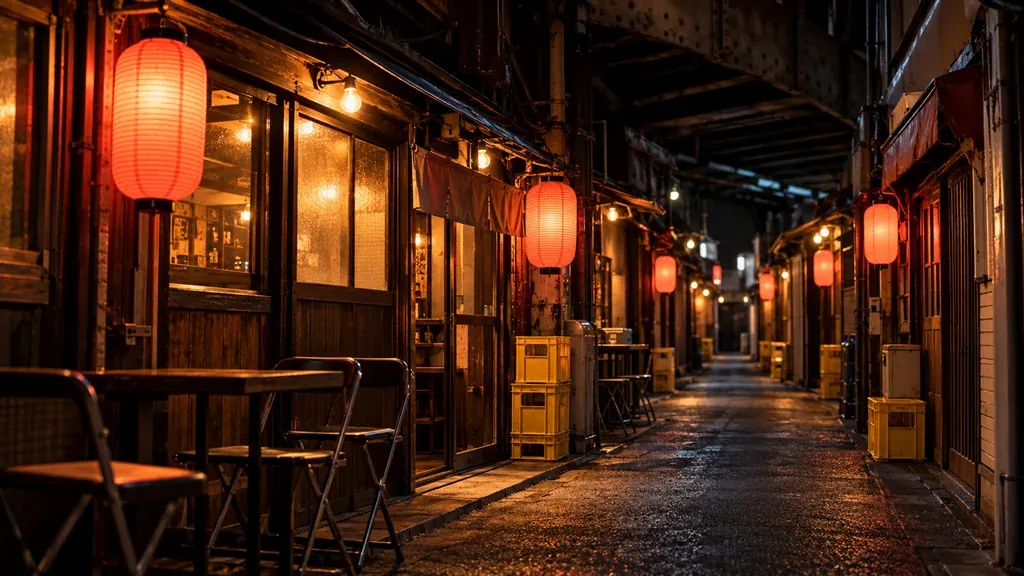
The market between Ueno Station and Okachimachi Station is about 500 metres long and holds roughly 500 shops and stalls, according to the Tokyo Convention and Visitors Bureau. It is reached from the Shinobazu Exit of JR Ueno Station at one end and the North Exit of JR Okachimachi at the other. It trades every day, but each shop sets its own hours.
That last point decides what Ameyoko is at night. The daytime shops and the Ameyoko Center Building, which closes at 20:00, are not part of a night walk. What stays open along and around the street are the venues listed on this site, several running to 1:00 or 5:00 and three never closing, so the route to Okachimachi passes lit, staffed premises rather than shutters.
The street's own association publishes what it is working on rather than reassurances: guidance on putting rubbish out at night as a fire-prevention measure, and an examination of security cameras.
The Metropolitan Police list Ueno and Yushima among the Tokyo districts where illegal touts operate, and name the areas around Nakamachi-dori and Kasuga-dori in particular. On the same page they record unauthorised credit card charges and cases in which drunk customers were made to withdraw cash from an ATM, mostly at venues a tout had led the customer into. Their advice is not to go with anyone who stops you in the street.
The rules behind that advice are strict and local. Touting in a public place for bars, izakaya, karaoke boxes and adult businesses is banned across the whole of Taito ward and the whole of Bunkyo ward, and each designates a stricter district: Ueno 2-chome, 4-chome and 6-chome in Taito, and Yushima 3-chome in Bunkyo. Inside those districts a tout who continues after guidance, a warning and a formal recommendation faces a fine of up to ¥50,000.
The metropolitan nuisance ordinance separately bans persistent touting anywhere in Tokyo, including blocking someone's path or following them. None of these rules penalises the customer. Nobody who stops you in the street is taking you to a venue on this site, and Chiba-chan states that it uses no touts and asks you to contact the restaurant if anyone claims otherwise.
Police boxes, called koban, are where you go for a theft, lost property or directions. There is one in front of the Asakusa exit of JR Ueno Station, one beside Keisei Ueno Station whose beat covers Ameyoko and the Ueno 2-chome nightlife area, and one by Shinobazu Pond. For an emergency the number is 110; the police also run #9110 for non-urgent matters, which they state works in English.
We will not tell you how a street feels at night, because that is not something we can check. What can be quoted is what each venue publishes about who its room is set up for.
More is on the solo travellers page.
Each of the six states the rule on its own pages, so what follows is the venue's own decision about its room rather than ours about the area. Two of them also require photo identification at the door.
Of the twenty Shinjuku venues here, four publish a rule about serving alcohol by age and the other sixteen do not state an age limit at all. Several of those sixteen say as much in writing: their official pages list an age limit as not stated.
The four that do publish something are all chain restaurants. TORIKIZOKU Shinjuku Higashiguchi states that people under 20 cannot come on their own, and may enter with a guardian or someone aged 20 or over on condition that no alcohol is served to them. KUSHIKATSU TANAKA Shinjuku Kabukicho states that under-20s may enter without an adult but are not served alcohol.
SHIROKIYA Kabukicho Sohonten and YAMAUCHI NOUJOU Kabukicho Godzilla Road both state that people under 20 are not served alcohol and that staff may ask for identification. Both also state that they do not serve alcohol to guests who arrived by vehicle, bicycles and electric kickboards included. OPEN BOOK in Golden Gai asks visitors to confirm they are 20 or over before entering its website, which is also an online shop, and publishes no condition about the bar itself.
Both areas have venues that never close, which is the one thing a walk at an awkward hour can be planned around. In Shinjuku, Isomaru Suisan Nishi-Shinjuku 1-chome No.3, ICHIRAN Shinjuku Chuo Higashiguchi and Sugoi Niboshi Ramen Nagi in Golden Gai are open 24 hours. SHIROKIYA Kabukicho Sohonten and Gallery Bar Albatross G both run to 5:00, and Sushizanmai Higashi-Shinjuku to 5:00 with last orders at 4:30.
In Shibuya, Isomaru Suisan Shibuya Udagawacho and ICHIRAN Shibuya are open 24 hours. Oreryu Shio-Ramen in Shibuya Center-gai serves until 7:00, Sushizanmai Shibuya Tokyuhontenmae until 6:00 with last orders at 5:00, and Oreryu Gyozaro until 5:00 with last orders at 4:30. AFURI Shibuya Dogenzaka runs to 5:00 on Friday and Saturday only, closes at 23:00 the rest of the week, and the full list is on What's open late in Tokyo.
Two of those Shinjuku venues are inside Golden Gai, where an address does not get you to a door. OPEN BOOK has no signboard and is the third shop in from the outside on the 5th street, where around 100 shops share the same street address, and Ramen Nagi is on the second floor of a building with ten counter seats. Albatross G is on the same 5th street.
Neither Shibuya club publishes a walking time from the station, only written directions. clubasia says to leave by the Hachiko Exit, go up Dogenzaka, turn right at the Dogenzaka Gosaro junction by the convenience store and walk down the hill, and the club is on the left. WOMB gives its address in Maruyamacho and a map, but no number of minutes on foot.
The Ueno sections above exist because the park, the market and the police each publish something we can quote by name. For Shinjuku and Shibuya we have no equivalent source, so there is nothing here about how busy a street is, how it is lit, or what the police say about either district. Adding any of that would mean writing something we cannot check, which our editorial policy rules out.
What is left for those two areas is the material above: published entry conditions, and published hours. For a route built only from those, see the Shinjuku night plan and the Shibuya page.
Because the park shuts at 23:00 and the temples shut in the late afternoon, a walk and a late night are two different evenings in Ueno rather than one. Do the outdoor part first: the park until 23:00, Yushima Tenmangu until 20:00, and Ameyoko between the two stations.
After that, what is open is indoors. Three venues never close — Isomaru Suisan Ueno 6-chome, ICHIRAN and Ramen Kamo to Negi, the last cash only — while TORIKIZOKU serves until 5:00 and the karaoke rooms on Ueno Chuo-dori run through the night. The closing times are on What's open late in Tokyo.
The first night plan puts the park, the market and a late venue in an order that respects these closing times, and day two and day three do the same for the rest of a stay. Tips on Manners and Transportation at Night covers the charges, house rules and age limits inside a venue, and our editorial policy explains why this page reports a disagreement between two official bodies instead of resolving it.
Ueno · Asakusa · Shibuya · Shinjuku · Roppongi · Ginza · Tsukiji · Tsukishima